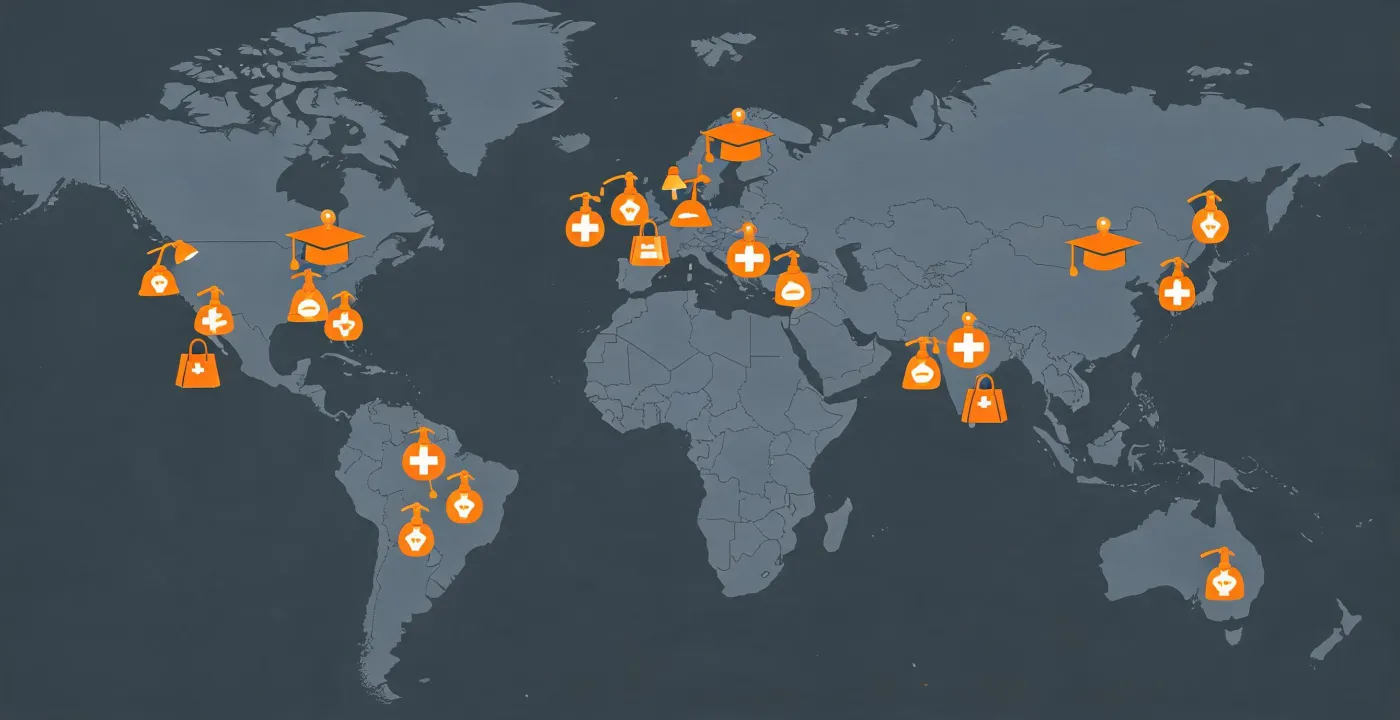
Application map

Acuity Brands lighting criteria across commercial environments

Regional codes and procurement paths vary, yet every useful brief starts with the same evidence: the task, mounting geometry, optical target, operating schedule, control method and maintenance plan.

Map of commercial lighting application regions and project types

Application requirements by operating context

North American commercial interiors

Office and education projects commonly combine recessed, linear and panel luminaires with 0-10V dimming, occupancy sensing and daylight harvesting. UL scope must be confirmed for the selected configuration. A nominal 4000 K, Ra 80 schedule is only a starting point; healthcare, hospitality and color-critical areas may require Ra 90+ or a broader TM-30 review.

European project specifications

DALI-2 coordination may connect luminaires, sensors and commissioning software. CE and RoHS applicability should be checked by product and destination rather than treated as a universal family claim. LDT files help calculation workflows, while the project model still needs mounting height, reflectance and maintenance assumptions.

Global hospitality and retail programs

Repeatable aesthetics must be reconciled with local voltage, emergency rules and supply routes. Beam angle and candela distribution affect accents; CCT consistency and color rendering influence materials. Mock-ups are most useful when evaluated at the expected dimming level and viewing distance.

What carries the most selection weight

Visual task and glare
94
Controls interface
86
Mounting and service access
82

The index is an internal briefing aid, not field performance data. It ranks the questions to resolve during a project intake; it does not compare manufacturers or predict energy savings.

Technical trade-offs to document

Maximum lm/W versus visual quality: higher efficacy can reduce connected load, while optics, UGR, CRI and spatial brightness may justify a different operating point. Centralized versus distributed controls: central supervision simplifies policy management; distributed zones can improve local flexibility and fault isolation. Integrated versus serviceable components: integration supports compact form, while replaceable drivers or light engines may reduce long-term maintenance disruption.

Rated L70 values depend on stated thermal conditions and extrapolation methods. IP ratings address ingress under defined tests, not chemical compatibility. A 10 kV surge option cannot replace a complete site protection strategy. Final illuminance depends on field geometry and surface conditions.

Map one application before scaling the schedule

Describe a representative room, its operating hours and control intent. The response will focus on verifiable selection inputs.